To The Victoria Falls
To The Banks of the Zambezi
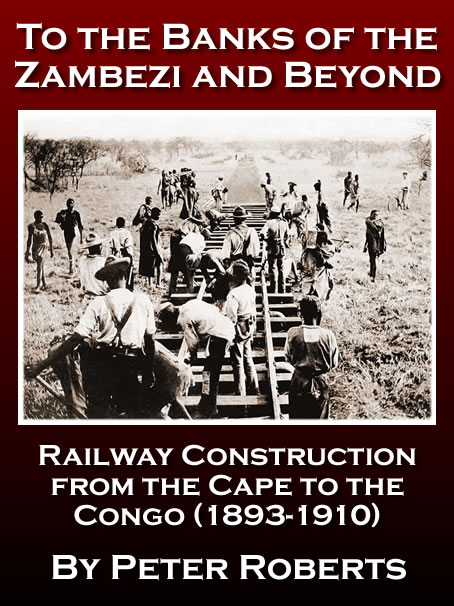
The following text is adapted from 'To The Banks of the Zambezi and Beyond - Railway Construction from the Cape to the Congo (1893-1910)', researched and written by Peter Roberts and first published in 2021. Please visit the Zambezi Book Company website for more information.
To the Banks of the Zambezi
Rhodes promoted details of his grand scheme to extend the railway to the Zambezi and beyond at a meeting of the Chartered Company’s shareholders in London on 21st April 1898.
"I want two million pounds to extend the railway to Lake Tanganyika - about 800 miles [1,287.5 km]... Look at the matter. You get the railway to Tanganyika; you have Her Majesty’s Government’s sanction for a railway to Uganda, and then you have Kitchener [and his railway] coming down from Khartoum. This is not imaginative: it is practical. It gives you Africa... the whole of it!" (Strage, 1973)
Many in London were shocked by his ambitious plans and the Government did not respond positively, possibly because more than half of Africa was already under the control of rival European nations across whose territory it would have to travel. City investors however were more interested, although not everyone shared Rhodes’ enthusiasm for the project.
"Sir William Harcourt, who thoroughly detested Rhodes, thought the scheme hair-brained, and never hesitated to say so. He was staggered, therefore, to find a Welsh steel mill hard at work manufacturing rails for the Cape to Cairo railway." (Rhodesia Railways Magazine, November 1957b)
With the extension of the railway to Bulawayo and opening of new horizons the board of the Bechuanaland Railway Company, under the chairmanship of Cecil Rhodes, decided to rename the construction company and on 1st June 1899 the Rhodesia Railways were born (Croxton, 1973).
Crossing the River
The consultant railway engineers Sir Douglas Fox and Partners had originally envisaged the route north would pass on through to the new capital of Salisbury (now Harare) and cross the Zambezi River over the Kariba Gorge, some 350 kilometres downstream of the Victoria Falls, before continuing north on to Lake Tanganyika. Sir Charles Metcalfe surveyed a possible route to the river in 1898.The country between Kariba and Lake Tanganyika, however, was found to be unfavourable terrain for the railway, and an alternative, less challenging and less expensive route was needed.
"As to the extension northwards my first idea was to go towards the Kariba Gorge, where coal was reported to be found (for no part of the railway was made for sentimental reasons), but on examination the coal was shown to be very inferior, and I had to report against the route." (Metcalfe, 1923a)
In September 1899 the Bulawayo Chronicle reported a surveying team was sent by Sir Charles to survey the middle sections of the Zambezi for a potential crossing.
"Mr T E Phillips, who left Bulawayo a short time ago, has been sent northwards by Sir Charles Metcalfe to examine the country along the Zambesi, together with the nature of its banks for a certain stretch, commencing about 100 miles [161 km] below Wankie’s. The object of this survey is to gather reliable information, from which it may be ascertain where a likely sport exists for the crossing of the Cape to Cairo railway, to give it its grandiose name, or the Gwelo northward extension, to give it its local name...
"It is practically certain that the line will cross at a point below the junction with the Kafui. It is hoped that a suitable crossing may be found not far from such junction, as on the other side a high plateau of great extent is situation, which would be easy of traverse and healthy; this plateau according to all reports is an extremely fertile one and eminently suited to stock raising and agriculture...
"The difficulty of finding a suitable crossing place is, however, very great, as the Zambesi runs to such an extent in steep gorges that it is no easy task to get at it for bridging purposes. The great desideratum is of course to find a spot where there is an easy approach and where a narrow span will suffice." (Bulawayo Chronicle, September 1899)
Black Stones that Burn
Large coal deposits had first been identified in the Wankie region (now known as Hwange) by a German prospector Albert Giese in 1893. Coal was essential to the continued expansion of the railway network, which had until then survived on the cutting of timber from forest reserves along the route of the line and expensive imported coal from the south to feed the engine furnaces.
Giese had been prospecting for gold in the Tati District in 1893 when he met two representatives of Chief Wankie who told him of ‘black stones which burned, and gave great heat.’ Intrigued, Giese travelled to investigate these reports, and in 1893 managed to collect samples of high quality coal. After the insecurity of the Matabele Rebellion of Giese returned to peg his claim, and in 1895 he visited a third time to peg a concession of 400 square miles (644 km²) on behalf of the Mashonaland Agency Limited.
"It seems that there is some uncertainty regarding the steps which the pioneer took to ensure the proper development of his discovery. However, it is known that, in 1895, he visited Wankie a third time to peg a concession of 400 square miles [644 km²]. This concession had been obtained by the Mashonaland Agency Limited from the British South Africa Company in consideration of the expenditure of certain monies in the area." (Fuller, 1954)
Located some 200 miles (320 km) north-west of Bulawayo, it was claimed that the discovery held sufficient high quality coal to last hundreds of years. A sample consignment was tested by a locomotive on the line to Bulawayo and declared to be ‘equal to the best Welsh coal’ (Rhodesia Railways Magazine, July 1955).
"In 1899 the Wankie (Rhodesia) Coal, Railway and Exploration Company was formed and, later, the rights acquired by the Mashonaland Agency were assigned to this new company. After several reconstructions the company became the existing Wankie Colliery Company Ltd. Coal was produced for the first time in November 1903, the main drift of No 1 Colliery having been sunk at a spot four miles [6.4 km] east of the outcrop first pegged by Geise. The railway from Bulawayo reached the Colliery in the following year. After this the annual rate of output rose steadily, passing 250,000 tons in the first year of the First World War; 500,000 tons in the last year of that war, and reaching 1,000,000 tons in 1927." (Fuller, 1954)
Apart from its economic and industrial significance, Giese’s discovery of vast reserves of high-quality coal would have a significant effect upon plans for the route of the railway. Giese would subsequently sell his stake and develop a series of trading stores from Bulawayo to the Falls, before eventually settling to farm in the Wankie district.
Doubting Alfred
Yet it appears some were still unable to see the potential of the railway. Major Alfred St Hill Gibbons (1858-1916), who led an expedition to un-mapped parts of the Upper Zambezi valley and visited the Falls in November 1895, still championed Livingstone’s belief that navigation of the river was the key to the development of the region.
Even after a failed attempt to navigate a steam-powered launch, the Constance, up the Zambezi in 1898 (Gibbons and his party were defeated by the impassable Devil’s Gorge), Gibbons still saw the river as the transport highway into the interior.
"No railway over the two thousand miles [3,218 km] separating Cape Town from the Zambezi can ever compete with a natural waterway in the conveyance of heavy goods, except where time is of course of more value than the goods themselves."
His belief was perhaps more surprising in that one of the objects of the expedition was to supply information relating to the nature of the Middle Zambezi for the planned crossing of the river by the railway.
"To furnish... Mr Cecil Rhodes with such information bearing on the character of the country as might be of assistance in the selection of a route for the projected trans-continental railway - more especially with reference to the crossing of the Zambezi." (Gibbons, 1904)
The Zambesi Express arrives at Bulawayo
|
References
Bulawayo Chronicle (September 1899) Cape to Cairo Railway - Crossing the Zambesi. 30th September1899.
Croxton, A. (1982) Railways of Zimbabwe
Fuller, B. (1954) Bid Time Return. De Bussy, Cape Town.
Gibbons, Major A. St H. (1904) Africa From South To North Through Marotseland. Volume 1 of 2. John Lane, London and New York.
Metcalfe, Sir C. (1923) My Story of the Scheme - The Story of a Famous Engineering Feat. [In Weinthal, L. [Editor] (1923), Vol.I]
Strage, M, (1973?) Cape to Cairo, Jonathan Cape.
Rhodesia Railways Magazine (November 1957b) ‘Cape To Cairo’ Scheme Still A Dream. Vol.6, No.7, p.31. [BRMA]
Weinthal, L. (1923) The Story of the Cape to Cairo Railway and River Route from 1887–1922 (Pioneer Publishing Co)
Further Reading
Roberts, P. (2021) To The Banks of the Zambezi and Beyond Railway Construction from the Cape to the Congo (1893-1910). Zambezi Book Company.
|
|
Search www.tothevictoriafalls.com:
|
'To The Victoria Falls' aims to bring you the wonder of the Victoria Falls through a look at its natural and human history.
This website has been developed using information researched from a wide variety of sources, including books, magazines and websites etc too numerous to mention or credit individually, although many key references are identified on our References page. Many of the images contained in this website have been sourced from old photographic postcards and publications and no infringement of copyright is intended. We warmly welcome any donations of photographs or information to this website.
 Website text © Copyright Peter Roberts 2012, All Rights Reserved.
Webpage design by EcoElements Digital Media Solutions
|