To The Victoria Falls
Development of the Victoria Falls
The following text is adapted from 'Footsteps Through Time - A History of Travel and Tourism to the Victoria Falls', researched and written by Peter Roberts and published in 2017. Please visit the Zambezi Book Company website for more information.
Prince Edward, Prince of Wales visits, 1925
In June 1925, His Royal Highness Prince Edward The Prince of Wales, later to become King Edward VIII (in 1936, before abdicating in less than a year), visited the Victoria Falls and stayed overnight in Livingstone as part of his extensive tour of southern Africa.
The South African Railways provided two special trains, one of which was specially built for the tour and comprised several luxurious saloons for the Prince and his party. The Royal Train was painted white with gold lining and lettering and became known as the White Train. A guiding pilot train was again used throughout the tour (Clark, 1952).
Travelling with the Prince was the usual hoard of journalists, photographers and reporters, including Ward Price, who records:
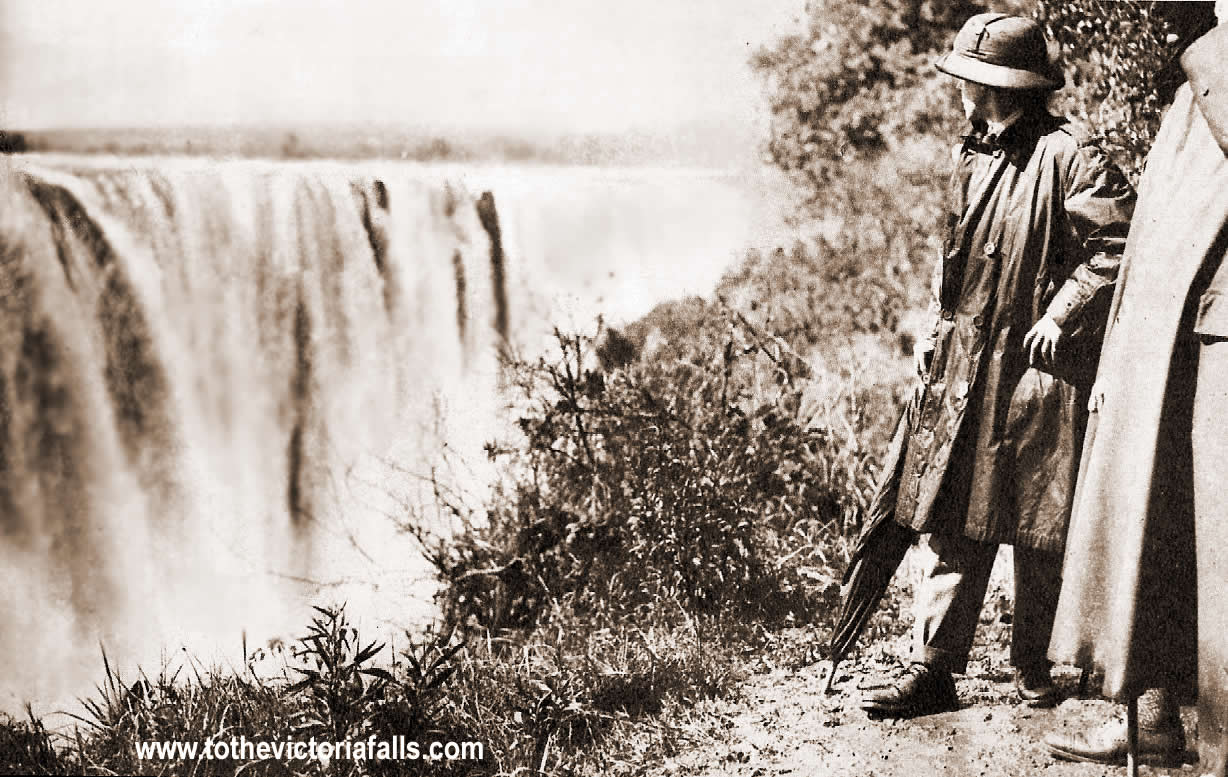
...about eleven o’clock on that morning of July 11th, looking out across the forest of tall trees through which the railway ran, we saw at last what we had long been waiting for – the white wall of smoke-like spray which rises eternally from the gigantic Victoria Falls. At first sight it looked like a shrapnel barrage above the green wall of vegetation, and when the train was still hundreded of yards away from the falls the spray was drifting in at its windows like fine rain." (Ward Price, 1925)
External Link: Pathe News Report - Prince of Wales Rhodesia Tour.
The Prince Edward, Prince of Wales at the Victoria Falls, 1925
The Prince toured the Falls for several hours guided by Sir Herbert Stanley, Governor of Northern Rhodesia, and was then taken upriver by motor-launch for lunch on Kalai Island.
"The dazzling, dizzy gleam of the rushing waters was hardly out of the Prince’s eyes or the roar out of his ears, when he found himself getting into a motor-boat only a few hundred yards above the Falls on a river that looked as placid as the Cambridge ‘Backs’. From there we passed up the broad, blue Zambesi between densely wooded banks, to Kalai Island, where a picnic lunch was set out under huge wild fig tree... The island luncheon party was delightful." (Ward Price, 1926)
Victor Pare, manager of the Hotel's guest services, recalled:
“His Royal Highness the Prince of Wales, when asked what he thought of our Rhodesian wonder, replied with a twinkle in his eye, ‘Damned wet.’ But I knew how it had impressed him. I had watched his eyes. He had seen most things worth seeing in the world and, perhaps for the first time, he was wonderstruck.” (Para, 1926)
And in the evening a dinner was held in Livingstone in his honour.
On his arrival at Livingstone yesterday the Prince received a magnificent welcome from the people of Northern Rhodesia. In the evening he attended the most georgeous ball of the tour, some hundreds of couples taking the floor in an amazing open-air ballroom constructed in the midst of flower borders and tall trees. The supper room also was of native structure, taking the shape of a vast grass hall, roofed with grass and palm leaves. The whole surroundings, in the glow of golden lanterns hanging still in the tropical air, were like a scene from fairyland." (Reuters, 14 June 1925)
Ward Price records:
"...[the] band of the native Northern Rhodesia Police, commanded by a band-master who was formerly of the first cornet of the Irish Guards, was conspicuous at the ceremony." (Ward Price, 1926)
The catering for the evening was provided by Livingstone Bakery, tea Room and Frascati Restaurant, set up in the same year by Herbert Rothkugel and Max Taube.
Ward continues;
"That night the Governor gave a dance in the grounds of the Government House, which the Prince enlivened by organizing a race among the black servants who were polishing the floor in the interval by dragging mats of its, one man sitting on the mat and the other towing him. The native ‘boys’ put so much zest into this competition that they swept several of the company, including the Governor, off their feet during its course...
"The Prince left the dance towards midnight and drive down the long straight road that leads to the Victoria Falls. A great honey-coloured half-moon was hanging low among the stars, and as the Prince’s car stopped by the edge of the eastern falls, a lunar halo could be seen, wan and pale, on the curtain of spray that hangs as a permanent pillar of cloud over the thundering abyss. It looked like the ghost of a lost rainbow haunting the gloomy chasm." (Ward Price, 1926)
One source records that the Prince enjoyed his evening so much he insisted the clocks be put back an hour to allow it to continue!
The following day the Royal Party travelled upstream above Katombora for a regatta reception hosted by Paramount Chief, Litunga, of Barotseland, Yeta III.
"The next day, July 13th, was given up to an elaborate water-festival arranged by Yeta III, Paramount Chief of the Barotse, who had come three hundred miles down river from Lealui, his capital, in his number-two-size State Barge, the principle one being too big to get through the rapids. At Kamujoma, where this up-river regatta took place, a big space had been gleared in the dense bush on the river bank and a series of picturesque huts built there in the native style, to be used as changing rooms, grand stands, and luncheon halls. Just before the Prince arrived, the Royal Barge appeared, driven along by forty paddlers in red kilts, caps and feather head-dresses, all standing upright. Amidships was huge white awning looking like a gigantic roc’s egg, from which Chief Yeta emerged, wearing an elaborately gold-laced uniform designed by order of the Colonial Office for his father, Lewanika, when he was received by Queen Victoria..."
Paramont Chief Yeta III receives HRH the Prince of Wales, 1925
The official reception was followed by luncheon, for which Yeta changed into a top hat and frock-coat, and afterwards there followed the native regatta. The latter had all the essentials for the success of such a function – calm weather, a smooth course, bright sunshine, and most important of all, many pretty girls in pretty frocks looking on. One could not help thinking, however, that the racing itself would have been judged unsatisfactory by the Henley standards. It reminded one more than anything of the race which Alice in Wonderland organized for the purpose of drying the animals who had fallen into the pool made by her tears, of which the only rules wre that the racers started when they liked, stopped when they liked, and must all be held to have won. The course was a very zigzag one, and the last three competing canoes finished locked in a sort of death grapple, with one of the half full of water...
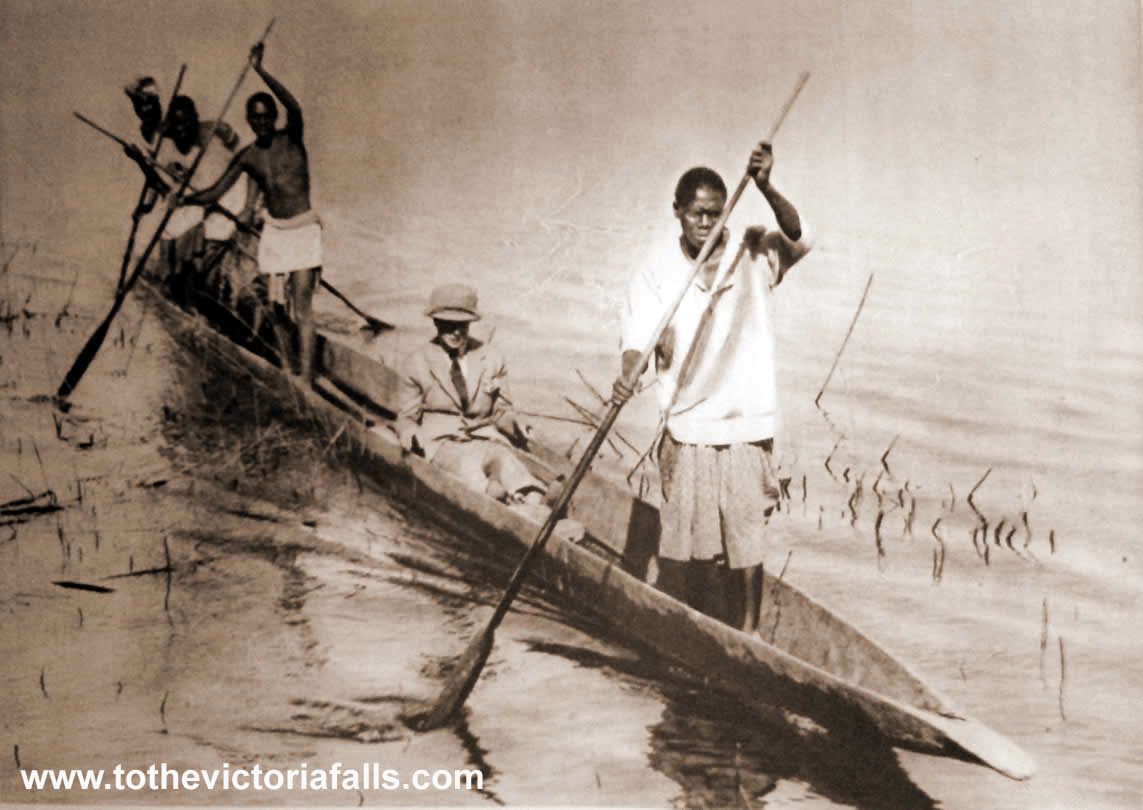
The Prince had congratulated the Barotses on their ability as watermen, which, he said, “appeals to people of our race, for our home, as some of you may know, is a group of islands surrounded by the sea, and from our earliest days we have prided ourselves on being skilled in the management of boats.” Rather to the alarm of his staff he now decided that he would make a short trip in one of the narrowest and lightest of the native craft. Two crocodiles had been seen floating past while we were at lunch, so that the naval members of his suite were dubious about the risks involved. “You had better turn out the guard, I may fall in any moment,” he said, as he pushed off in a frail-looking dugout canoe propelled by five paddlers.
HRH the Prince of Wales in native canoe, 1925
The excursion, which delighted the Barotse tribesmen, passed off, however, without the Heir to the Throne having to swim ashore through crocodile-infested waters, though the Prince alleged afterwards that he felt as if to close one eye while keeping the other open would have been enough to upset the craft." (Ward Price, 1926)
The Prince was due to visit Northern Rhodesia again during the course of a hunting trip with the Duke of Gloucester in 1928, but due to the serious illness of His Majesty King George V, he was urgently recalled to England.
Another story related to the Royal visit recalls the journey of the Paramount Chief's sister, Morena Mukwae, to Livingstone. She wss described as being of exceptional size and weight, and resided at Nalolo on the banks of the Zambezi some three hundred miles north-west of Livingstone. Most of this journey was undertaken by barge, but near Katombora the Barotse royal party transfered to the Zambezi Saw Mills Railway for the last stretch to Livingstone. Due to her girth, it was found to be impossible for the royal lady to pass through the doorway of the carriage. A specially-made large armchair was securely fixed to the open wooden floor of an open sided wagon, a carpet laid, and surrounded by her retainers sitting in smaller chairs the noble lady was solemnly conveyed to Livingstone.
|
Recommended Reading
Clark, P. M. (1936) Autobiography of an Old Drifter. Harrap, London.
Croxton, A. (1982) Railways of Zimbabwe (originally published as Railways of Rhodesia)
Frew (1934) Prince George's African Tour
Ward Price (1926) Through South Africa with the Prince
Further Reading
Roberts, P. (2021) Footsteps Through Time - A History of Travel and Tourism to the Victoria Falls. Zambezi Book Company.

|
|
Search www.tothevictoriafalls.com:
|
'To The Victoria Falls' aims to bring you the wonder of the Victoria Falls through a look at its natural and human history.
This website has been developed using information researched from a wide variety of sources, including books, magazines and websites etc too numerous to mention or credit individually, although many key references are identified on our References page. Many of the images contained in this website have been sourced from old photographic postcards and publications and no infringement of copyright is intended. We warmly welcome any donations of photographs or information to this website.
 Website text © Copyright Peter Roberts 2012, All Rights Reserved.
Webpage design by EcoElements Digital Media Solutions
|