To The Victoria Falls
Development of the Victoria Falls
From Croydon to Cape Town
In February 1931 Imperial Airways introduced the first regular weekly air mail service from England to Central Africa, terminating at Mwanza on Lake Victoria and taking ten days to cover the 5,124 mile (8,246 km) route. In December the service was extended experimentally to Cape Town for the carriage of Christmas mail. The aircraft used on the last section, DH.66 (G-AARY) ‘City of Karachi,’ arrived in Cape Town on 21st December 1931.
On 20th January 1932 Imperial Airways launched the first weekly air mail service to Cape Town, the Handley Page HP.42 (G-AAXF) ‘Helena’ departing from Croydon on Wednesdays on the first leg of a journey that initially involved five different aircraft and two train transfers over the eleven day journey. The mainly east coast route included stops at Cairo, Nairobi, Broken Hill, Livingstone and Bulawayo.
“Captain A B H Youell, in the Handley Page HP42 ‘Helena,’ set course for Paris on the first leg of an 8,000 miles [12,875 km] journey that was planned to include five aircraft and two train trips on the 11 day service. Surprisingly little fanfare marked the occasion, but it was an historic moment in the annals of British aviation... At last, after more than a decade of frustrated hopes, Imperial Airways, the ‘chosen instrument’ of British air imperialism, was linking Cairo and Cape Town, the twin citadels of British power and presence in Africa.” (McCormack, 1974)
From 27th April the route was opened to passengers, with flight from London to Cape Town costing £130.
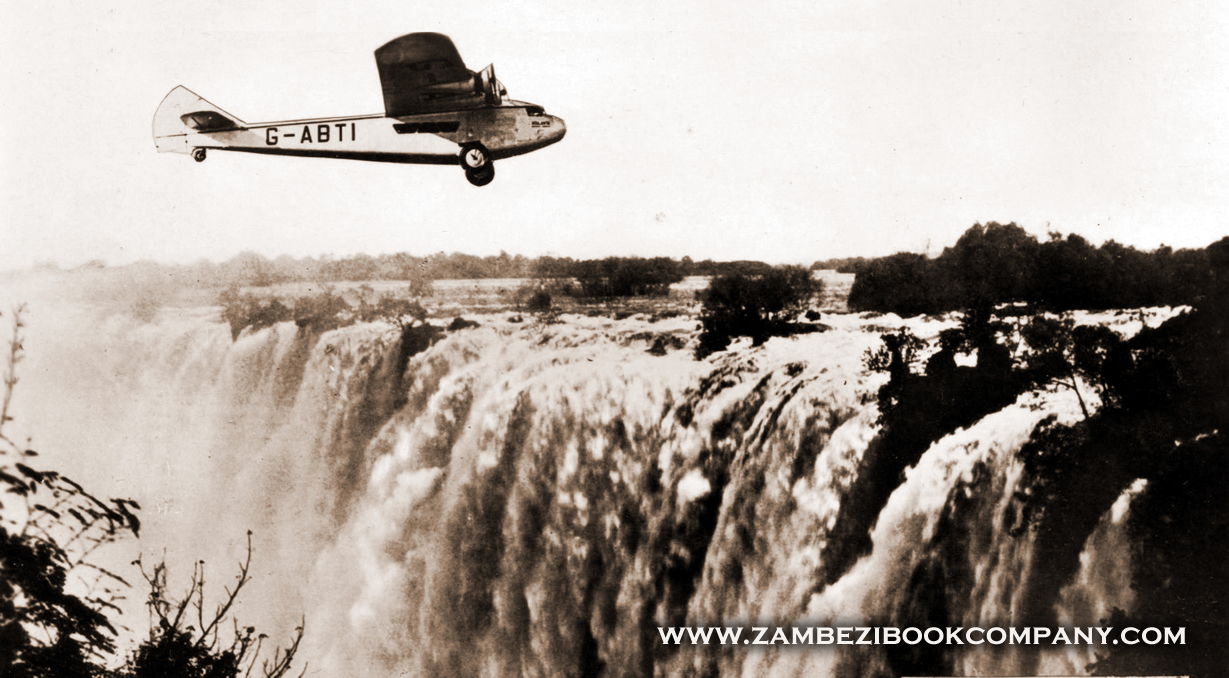
Imperial Airways Armstrong Whitworth Atalanta (G-ABTI)
In early 1933 the first Imperial Airways Armstrong Whitworth Atalanta (G-ABTI), ‘Artemis,’ flew from Croydon to Cape Town. Three other aircraft soon after arrived to jointly operate the service between Kisumu (Kenya) and Cape Town. A few years later these craft were replaced by the larger de Havilland DH.66 Hercules which were well suited to the African conditions. In November 1934 the British Government introduced the ‘Empire Air Mail Scheme’ to carry mail to many parts of the world, leading to significant and increasing demand for cargo space on aircraft and plans for a new generation of heavy duty aircraft - the C Class flying-boat.
Record Breakers
During the early 1930s a succession of pilots in a variety of planes broke the record for the fastest transit from England to the Cape. In April 1930 the 64-year-old Duchess of Bedford, with Captain Charles D Barnard (pilot) and Mr R Little in the Duchess’s Fokker monoplane (G-EBTS) nicknamed ‘The Spider’ reached Cape Town in 10 days (with a total 91 hours and 20 minutes flying time).
The following year Lieutenant-Commander Glen Kidston, supported by Lieutenant Owen Cathcart Jones and L A Valletti (wireless operator - replaced by L Johnson for the second half of the flight), flew a Lockheed Vega (G-ABGK) to the Cape in a new record of six days and 10 hours. Kidston died two months later, crashing while flying a Puss Moth over the Drakensberg Mountains.
In April 1932 Mr James A Mollison, flying solo in a de Havilland Puss Moth (G-ABKG), arrived at the Cape in a time of four days 17 hours and 25 minutes. In November Mollison’s new wife, Amy Johnson, flying another Puss Moth (G-ACAB) ‘Desert Cloud’ claimed the record, with a time of four days six hours and 54 minutes.
A Fatal Mistake
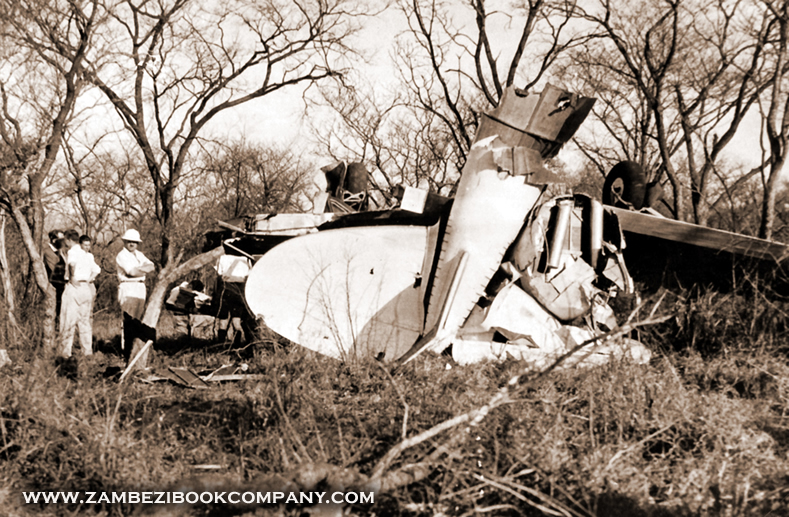
One of the earliest accidents recorded at the Victoria Falls Aerodrome on the south bank was a fatal crash which occurred in 1932 during an attempted ‘round-the-world’ tour undertaken as a publicity stunt for the American Metro-Goldwyn-Mayer Film Corporation. Piloted by Captain James Dickson and carrying Mr Arthur Loew, Vice-President of M.G.M, and his assistant, Mr Joseph Rosthal, the Lockheed Orion 9A (NC12229) ‘Spirit of Fun’ monoplane crashed on take-off.
“The world flight of Mr Arthur Loew came to an unfortunate end at Victoria Falls on November 18th. It appears that the pilot, Capt. James Dickson, landed at the Victoria Falls aerodrome, mistaking it for the Livingstone aerodrome, nine miles [14.5 km] distant. While trying to take off again the wheels of the Lockheed ‘Orion’ monoplane sunk into the soft sand of the aerodrome, causing the machine to turn over and crash into a tree. Mr Dickson was killed and his two passengers, Mr Loew and his secretary, injured.” (Flight Magazine, November 1932)
The wreck of the Spirit of Fun
At the inquest it was recorded that Captain Dickson had been unsure of the conditions when he decided to take-off. He was recorded as remarking on the utter absence of wind and pointing out the obstacle saying that he should not care to hit it - which unfortunately he did.
Regional Routes
The Rhodesian and Nyasaland Airways (R.A.N.A.) were formed on 12th October 1933. At the outset R.A.N.A. owned one Fox Moth (VP-YAD), and four Puss Moths - two inherited from the now defunct Rhodesian Aviation Company which had gone into voluntary liquidation to form the new company. The first routes linked Salisbury, Bulawayo, Livingstone, Broken Hill, Lusaka, Ndola and Blantyre.
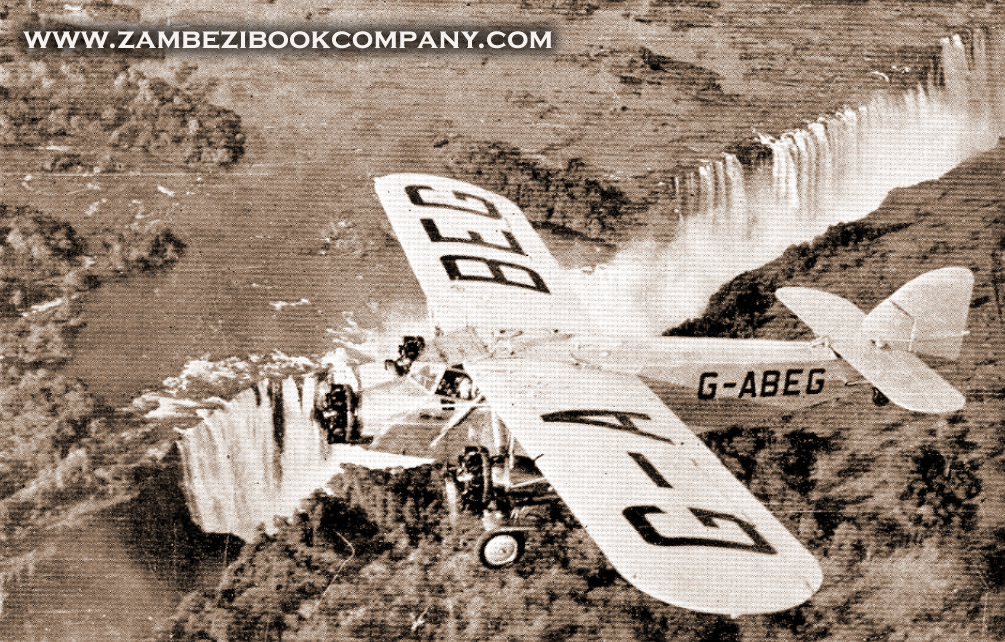
Operating on the Bulawayo-Livingstone route from April 1934 was a Westland Wessex Airliner (G-ABEG) hired from Imperial Airways. Soon after, in 1935, de Havilland Rapides were ordered from England, this type of aircraft serving Central Africa for many years.
Westland Wessex Airliner (G-ABEG)
Formation Flights
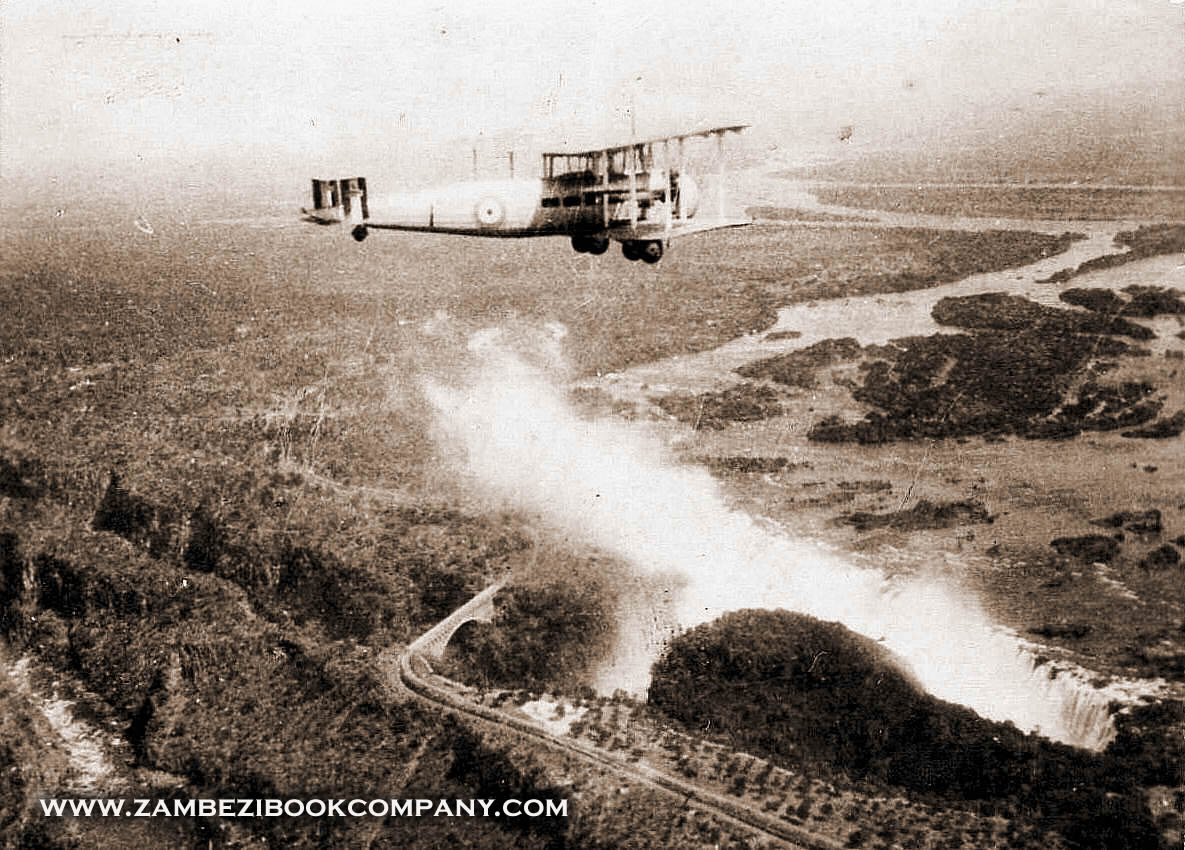
Following the annual R.A.F. formation flights undertaken the late 1920s, in 1931 Squadron-Leader Hubert W G J Penderel commanded a formation of three R.A.F, No. 216 Squadron Vickers Victoria troop carriers (capable of carrying up to 23 full equipped men in addition to the two-man crew) on a 12,000 mile (19,300 km) proving flight from their base at R.A.F. Heliopolis, Cairo, to the Cape and back. In the years that followed increasing numbers of R.A.F. planes made the journey, with two Vickers Victoria and four Fairey Gordon planes visiting Bulawayo and Salisbury in January 1934, and in March the same year four Vickers Victoria (No.216 Squadron) and five Fairey IIIF (No.45 Squadron) planes undertook the journey to the Cape, returning later the same month. The Vickers Victoria planes from No.216 Squadron landed at Livingstone during the tour.
Vickers Victoria troop carrier over the Falls
Records Rewritten
In May 1936 Amy Johnson made her last record-breaking flight, reclaiming her England to Cape Town record in a Percival Gull Six (G-ADZO) in a time of three days, six hours, 29 minutes and becoming the only person to hold the record on two occasions. In 1939 pilot Alexander A D Henshaw flew his modified Percival Mew Gull (G-AEXF) to the Cape in an incredible 39 hours and 23 minutes. After just 28 hours rest in Cape Town he made the return journey in 39 hours and 36 minutes, completing the 12,754 mile (20,525 km) round trip in a total of four days, ten hours and 16 minutes, breaking the record for each leg and for the round trip. Henshaw’s record solo flights remained unbroken for over seventy years.