To The Victoria Falls
Development of the Railway
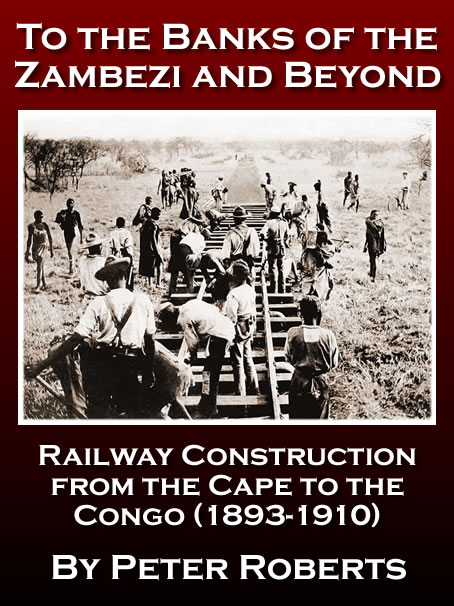
The following text is adapted from 'To The Banks of the Zambezi and Beyond - Railway Construction from the Cape to the Congo (1893-1910)', researched and written by Peter Roberts and first published in 2021. Please visit the Zambezi Book Company website for more information.
Pauling & Co
Mr George Craig Sanders Pauling (1854-1919), an English engineer, would become the man most closely associated with the building of the the railway into the interior. Born in England in 1854 George Pauling, together with younger brother Henry Richard Clarke Pauling (1857-1897), followed his father, Richard Clark Pauling (c.1833-1894), to Africa at the end of 1875. George Pauling’s father and great-uncle were both railway engineers working in the Cape Colony.
"About the middle of the year 1874 my father had obtained an appointment as an engineer on the Cape Government Railways... Our grand-uncle, Mr Henry Pauling, had been an engineer on the Cape Railways from the commencement of their construction, and at that time he was chief engineer of the Western Province Railways. This, however, had nothing to do with the appointment of my father as an engineer in Africa, as all the staff were engaged in England by Sir Charles Hutton Gregory, who was then consulting engineer to the Cape Government...
"We reached Cape Town after a voyage extending to thirty days. I expected my father to meet me at the docks. He did not, however, put in an appearance and I began to wonder what I should do. As a stranger in a strange land with only one half-sovereign in the world, my outlook was not inspiring. From the docks I went up into the town, and after making some enquiries found him with some companions in the Fountain Hotel. He seemed very pleased to see me and excused himself for not having met me on my arrival. He asked me many questions about the voyage and inquired how I was off for cash. I told him that all that remained to me was half a sovereign. Where-upon he suggested that I should get a hole bored in it and wear it on my watch-chain, prophesying that in the years that were to come, when I should become an African magnate, I could always regard it with pleasure as a memento of my financial circumstances when I first arrived in Cape Town. In less than half an hour he had borrowed the same half-sovereign to meet his immediate obligations." (Pauling, 1926)
In 1859 Mr Henry John Pauling (1821-1892) had been appointed District Engineer, under Mr Brounger, and was responsible for overseeing the construction of a 25 mile (40 km) section of the Wellington line for the Cape Town Railway and Dock Company. In 1864 he became Resident Engineer for the line, a post which he held when the Cape Government took over the railway in January 1873.
It was not long before George Pauling obtained his first independent construction contract for the Waai Nek tunnel on a railway line near Grahamstown.
"My instructions were to supervise the work in the tunnel and on each side of it, but I thought it would be more remunerative if I were to obtain a contract... Having no money, I was face to face with the eternal problem of finance, but I got out of the difficulty by arranging with a good firm of merchants in Grahamstown to put up a store at the tunnel to supply my men with provisions, and the other necessities and luxuries of life, and I was shrewd enough to make it a condition that they should give me financial assistance to get the work started and that they should also pay me one-third of the store profits. Their assistance was really only necessary for the first month, because the price I had got for the tunnel was excellent and yielded considerable profit."
A giant of a man in stature and personality, Pauling in his prime reportedly weighed 250 lbs. (113 kg), with strength befitting that mass. He was a forceful and colourful character, noted for his drive, capacity for hard work and physical strength.
"My appetite, both for liquids and solids, has always been a source of amusement, and sometimes of concern, to my friends. I had a particular partiality for German beer, which was, in a minor degree, shared by Messrs Lawley and Moore. On one trip of forty-eight hours up the Beira Railway we drank, between us, three hundred bottles of this excellent refreshment.
"On another occasion, about the same time, I had a memorable breakfast at Delagoa Bay. Three of us - I refrain from mentioning the names of my companions - had a thousand oysters with about eight bottles of champagne. The oysters were small, but of a very delicate flavour. There is much virtue in a good appetite, so long as one is able to foot the bill." (Pauling, 1926)
Mr Hugh Marshall-Hole wrote of Pauling:
"[He] was a man of shrewd business qualities, and indomitable enterprise. When the history of the development of South Central Africa is recorded the name of Pauling will take a place among its Pioneers second only to that of Rhodes." (Marshall-Hole, 1923)
For some years his railway contracting activities alternated between Africa and the Middle East, where he built the line from Heifa to Damascus in Syria. "In my time," he wrote, "I have had submitted to me schemes for work in nearly every country in the world – from Alaska to New Zealand, from Manchuria to Peru." One of the then fanciful schemes that he investigated was for a tunnel under the English Channel at Dover.
In 1926, seven years after his death of influenza in 1919, the memoirs of George Pauling were published privately under the title ‘Chronicles of a Contractor’ (reprinted in 1969 as part of the Rhodesia Reprint Library series).
Cape Contracts
George Pauling formed various partnerships and companies in order to bid for construction contracts in South Africa, including Firbank, Pauling and Company, formed in 1881 with Mr Ralph Firbank, under whose company Pauling had trained back in England. Their first contract, the Grahamstown to Port Alfred line, started in October 1881, was a severe strain on their limited financial resources. Mr Ralph Firbank died from heart failure in 1882, with his brother Christopher taking over his role in the Company. The 65 mile (104.6 km) line included construction of the spectacular Blaauwkrantz Railway Bridge and was opened in November 1884.
Firbank, Pauling and Co successfully secured further railway contracts, including in the early 1880s a contract for the construction of 98 miles (157.7 km) of line from Sterkstroom to Aliwal North (opened September 1885) and, in 1884, the 78 mile (125.5 km) extension of the Cape line from the Orange River to Kimberley.
"Some time, however, before I finished the Aliwal North contract, on which I had reason to believe I had given satisfaction to the authorities, some of my Cape Town friends told me that the Government wished the Kimberley extension to be built as rapidly as possible, and that, although they could not give my firm the contract without calling for tenders, they would favourably consider my tender if it were at all possible. The one essential condition was rapidity in construction... My tender was successful and I immediately set to work to organize a competent staff and to commence operations."
Pauling again encountered financial difficulties in the contract, primarily caused by the demands of the Cape Government engineers who insisted on rigid interpretation of the contract and, in particular, excessive specifications for the station buildings at Kimberley.
"The Kimberley contract was a peculiar one. No final definitive survey had been made. The survey on which I tendered I had understood to be provisional, and I was aware of several places where much work could be cut out without addition to the working costs of the line, and I naturally considered that I should be allowed to make these deviations. I had not reckoned, however, on the consistent hostility of the Government engineers...
"There had been no time to prepare designed for the buildings and the yard, and a clause was inserted in the specification that the station accommodation was to be similar to that at Graaff Reinet, but somewhat larger. I was aware of the cost of the station accommodation at Graaff Reinet and in my tender had allowed for more than double what had been provided there.
"When the Kimberley Station plans were presented to me I found that the required accommodation exceeded that at Graaff Reinet by more than seven times, and that the rail level of the whole of the station yard was to be from two to four feet below the surface of the ground. The ground surface was practically dead flat, covered with a few inches of sand, and under that sand there was the hardest kind of rock, much of it being agate. I at once protested against the sinking of the rail level, and pointed out that by an alteration of grade, which would in no way increase the working cost of the traffic, the station yard could be laid on the surface of the ground, thereby avoiding the removal of any of the hard rock. The engineers, however, refused to agree to my suggestion and I was forced to lose from £15,000 to £20,000 in the unnecessary excavation of the adamantine rock."
The through first train arrived at Kimberley, 647 miles (1,041 km) from Cape Town, on 28th November 1885. Pauling, however, was increasingly struggling to raise the cash to pay his sub-contractors to complete the station buildings to the demanding specifications insisted upon by the Government engineers. With pressure increasing from his creditors, Pauling was left with only one option.
"I shall never forget the day on which old Moses Cornwall, the High Sheriff at Kimberley, and a very good friend of mine, came to me and said, ‘Pauling, you will have to keep indoors from sunrise to sunset or I shall have to arrest you as I have a judgement against you.’ This settled the question. I immediately wired to one of my friendly creditors to make the firm of Firbank and Pauling bankrupt, and Christopher Firbank saw our lawyers in Cape Town and we sent in our papers." (Pauling, 1926)
|
|
Search www.tothevictoriafalls.com:
|
'To The Victoria Falls' aims to bring you the wonder of the Victoria Falls through a look at its natural and human history.
This website has been developed using information researched from a wide variety of sources, including books, magazines and websites etc too numerous to mention or credit individually, although many key references are identified on our References page. Many of the images contained in this website have been sourced from old photographic postcards and publications and no infringement of copyright is intended. We warmly welcome any donations of photographs or information to this website.
 Website text © Copyright Peter Roberts 2012, All Rights Reserved.
Webpage design by EcoElements Digital Media Solutions
|