To The Victoria Falls
Development of the Victoria Falls
The following text is adapted from 'Sun, Steel & Spray - A History of the Victoria Falls Bridge', researched and written by Peter Roberts and first published in 2011. Please visit the Zambezi Book Company website for more information.
Bridge Reconstruction
Urgently required upgrades were carried out to the Bridge in 1929, strengthening the structure to allow for heavier train loads and the addition of a road and pedestrian footway, removing one of the two sets of rails. The whole of the original deck of the Bridge down to the underside of the cross girders was replaced with a stronger, wider and higher deck. The works were detailed in the Rhodesia Railways Bulletin of November 1929:
"During the past 25 years the weights of engines and rolling stock have steadily increased, so that the present loads of trains are far higher than were dreamed of when the Bridge was built. It was therefore decided to strengthen the Bridge to enable it to carry trains with 20-ton axle loads, thus leaving a considerable margin for future increases in the weights of engines and rolling stock.
"At the time of the building of the original Bridge, road traffic was negligible, and it was therefore considered not necessary to provide a bridge to carry road vehicles. This has now been changed by the tremendous progress made in the development of motor vehicles. In designing, therefore, the alterations now being made to the Bridge, provision was made for the inclusion of a motor road, and this road over the Falls Bridge will form an important link in the Great North Road... To obtain a road wide enough to take two streams of traffic and to allow pedestrians ample footway free from danger, it has been necessary to increase the width of the deck by about 13 feet [4 m], the added width being obtained by an overhang on either side of the Bridge." (Rhodesia Railways Bulletin, November 1929)
The new deck improved the overall strength of the original structure whilst also raising the level of the deck and rails, addressing two shortcomings of the original design and construction. At the time of the presentation of his report on the Bridge to the Institute of Civil Engineers, London, in 1907, Mr R J G Read observed:
"The cross girders carrying the floor were placed along the top chord, at and between the intersections of the bracings. This brought a secondary stress upon the top member which was said to be provided for; but it seemed that the intermediate cross girder might have been omitted, and the cross girders rested on the intersection of the bracing. The girders would have had to be a little deeper, and that would have raised the roadway higher." (Hobson, 1907)
The flaw in the original design appears to have been the major motivation for the upgrade:
"The old deck consisted of cross girders 12 ft. 6 in. [3.8 m] apart, which had the disadvantage of placing a load midway between the panel points of the Bridge, thus introducing a bending load on the top chord of the arch. The new deck will do away with this, the cross girders being spaced on the main span 25 feet [7.62 m] apart and coinciding with each panel point. This needs a much deeper type of girder for the rail bearers, and the new cross girder is therefore raising the rail level 4 ft. 7 in. [1.4 m]."
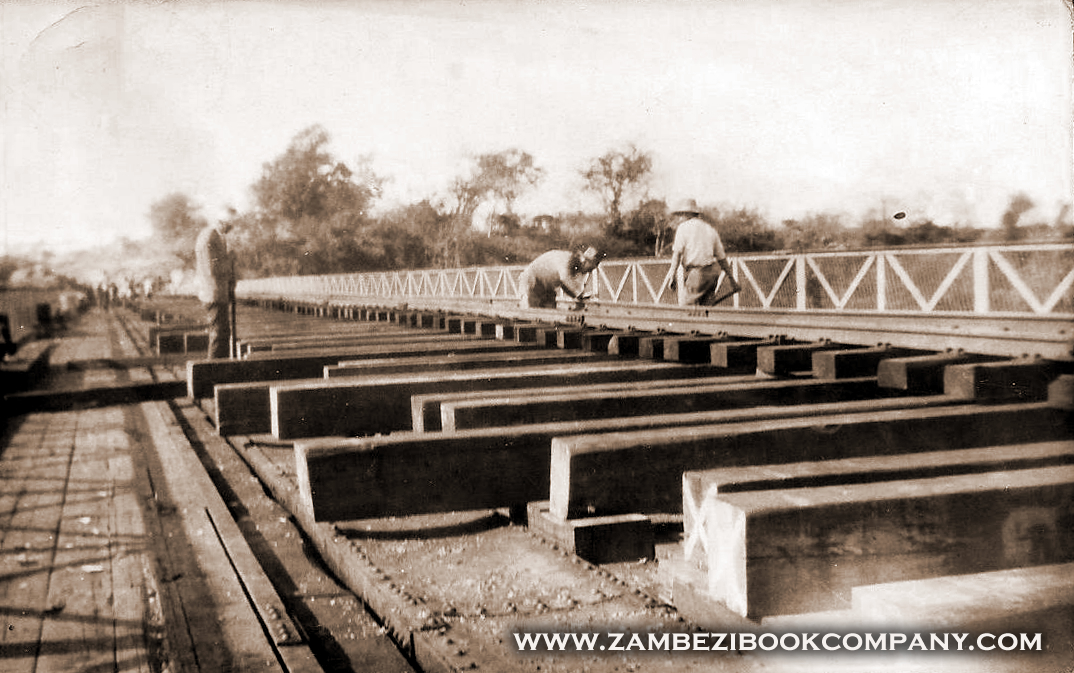
The contract for the replacement deck was drawn up in December 1928, the work again being awarded to the Cleveland Bridge Company. The contract timetable committed to the erection of a 25 foot (7.62 m) bay of the new deck each week. Rail traffic over the Bridge continued throughout the reconstruction, with the rails raised to their new position under a temporary supporting structure.
"Before the erection of the new steelwork could be commenced, the track over the bridge had to be raised on temporary structures to the new level and also moved to a new alignment at as near the centre of the Bridge as possible. The new design of the Bridge deck permits one line of railway track only." (Rhodesia Railways Bulletin, November 1929)
Raising the level of the lines
The contractors were allowed only 14 hours, one day a week, during which they could hold up traffic. In the event traffic was only delayed between 8 to 10 hours each period. The total cost of the contract was just over £32,870. The work commenced on 23rd July 1929 and the last section was placed into position on 4th December, with only minor stoppages of the heavy railway traffic passing over the Bridge.
"The contractor’s plant consists of a Smith’s 7-ton locomotive steam crane, and a large steam boiler which supplies steam for the running of a steam-driven air compressor. This compressed air is used for working the pneumatic riveting hammers and a drill. Steam is also provided to run an electric generator, which supplies current for working two electric drills and, in case of need, supplies electric light. They also have an oxy-actylene plant for burning through certain parts of the existing deck to facilitate removal. As a stand-by they have a portable air compressor driven by an internal combustion engine." (Rhodesia Railways Bulletin, November 1929)
Reconstruction of the top deck
Additional works to the structure of the Bridge included strengthening of the two bottom chord members of the bridge at both ends of each arch by the addition of side plates to the existing members; strengthening of the bottom cross bracing of the bridge by addition of transverse lateral struts; replacement of bolts on some of the existing connections of the principle members of the main span; and the cleaning and adjustment of bearings at the ends of the approach spans.
The contract also detailed that all new steelwork was to be painted with red lead and pure boiled linseed oil paint on both meeting surfaces of any steel plates or sections before they were to be installed and riveted. Afterwards the new steelwork was to be cleaned, scraped and painted again with a coat of red lead and linseed oil before the final two coats, "the first of Dampney’s Graphite and the second of Dampney’s Miraculum of light grey colour or other approved paints."
Excavating the new road approaches to the Bridge took some time, as blasting was not allowed so close to the Bridge and all the work had to be carried out by hand.
"The road approaches to the motor crossing are now being cut [March 1930]. As no blasting is permitted within half a mile of the bridge, and the rock is basalt, the work will take some time, but it is anticipated that the bridge will be open to road traffic at the end of March next." (Powell, 1930)
First to Cross
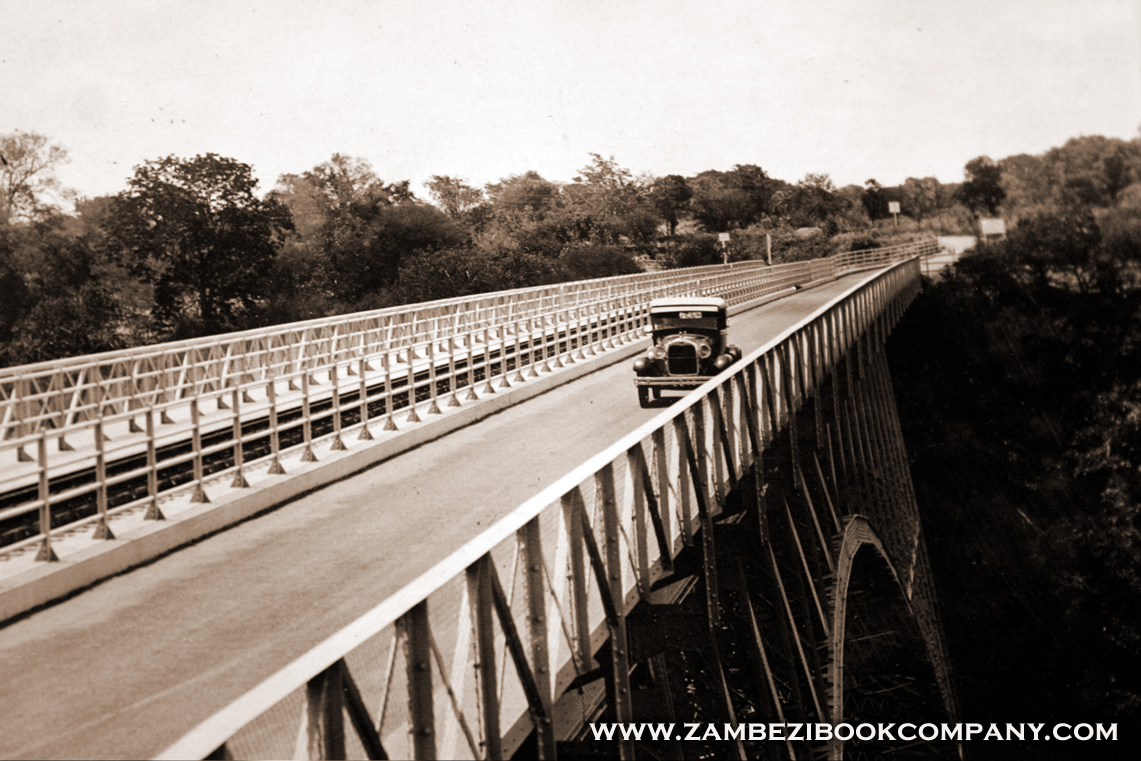
The road across the Bridge was opened in 1931 and the first member of the public to cross in a private vehicle was Ms Marina King who, with a friend, was travelling to Cairo in a Morris Cowley. She records in her autobiography ‘Sunset to Evening Star,’ that she was, however, disappointed to have been beaten to the honour of being the first across the new road by a Mr C K Thompson, a railway engineer who was closely associated with the work. He had crossed in a motor vehicle less than an hour earlier.
Ms King crosses the bridge